Thursday, November 10, 2022

How Hopi people hand built pots...

       Just below is the original page with illustrated instructions for hand built Hopi pots. There is also a great deal of text included in this page so I have numbered a copy at the bottom and recorded the text so that it may be translated for those visitors who do not read English. 

       The text for the same illustrated process with numbers identifying each description beneath the pictures...

Translation of Text:

  1. A basket or a bowl may be used for forming clay coil pottery over it.
  2. The Hopis also use tin basins for starting their pottery forms.
  3. The Indian potter considers it taboo to use the index finger in pottery shaping.
  4. A gourd or shell fragment for surface scraping and a basket or bowl for easy turning of work.
  5. The Spanish brought to the Mexican Indian, glazes, and stamping of motifs with wood blocks.
  6. A smooth round stone burnishes the clay surfaces just before it is dry.
  7. A helpful turn table may be made with little work.
  8. Indian women do all the pottery. 
  9. Indian men do all their embroidery.
  10. When pottery is dry it can be burned in the open by placing can wedges between the pottery, covering the entire group with paper, excelsior and wood for firing.
  11. Pottery pigments ordinary mineral oxide colors such as are used for coloring cement, mixed with water and clay will fire if painted on the pottery. Burnt Umber, Venetian Red, Yellow Ochre, Burnt Sienna, Indian Red may be used.
  12. Step on cans to make wedges.
  13. Discarded iron kettles with covers or sheet metal for covers make containers for firing pottery in the open. Wood and other fuel is piled over and around kettles.

Saturday, November 5, 2022

Illustrations of Totem carvings

       Haida  are an indigenous group who have traditionally occupied Haida Gwaii, an archipelago just off the coast of British Columbia, Canada, for at least 12,500 years.

Discussion about a memorial totem pole.

       The Haida are known for their craftsmanship, trading skills, and seamanship. They are thought to have frequently carried out raids and to have practised slavery. The Haida have been compared to the Vikings by Diamond Jenness, an early anthropologist at the Canadian Museum of Civilization. Read more...


Illustrated totem poles

Animal totem pole motifs from the Haida Indian of the North Pacific sections of
North America. These plates show strong positive design arrangements,
a good influence for the hesitant over-detail-inclined student to study.

Motifs by modern American Pueblo Indians

        The Puebloans or Pueblo peoples, are Native Americans in the Southwestern United States who share common agricultural, material, and religious practices. Currently 100 pueblos are actively inhabited, among which TaosSan IldefonsoAcomaZuni, and Hopi are the best-known. Pueblo people speak languages from four different language families, and each Pueblo is further divided culturally by kinship systems and agricultural practices, although all cultivate varieties of maize. Read more...

Symbolic language of the Pueblos people and their meanings.

Bird motifs by Pueblo Natives.

Designs in color by Pueblo Natives.

Pottery by artist Marie Martinez.

Designs by Zuni Native Americans

       The Zuni (ZuniA:shiwi; formerly spelled Zuñi) are Native American Pueblo peoples native to the Zuni River valley. The Zuni are a Federally recognized tribe and most live in the Pueblo of Zuni on the Zuni River, a tributary of the Little Colorado River, in western New MexicoUnited States. The Pueblo of Zuni is 55 km (34 mi) south of Gallup, New Mexico. The Zuni tribe lived in multi level adobe houses. In addition to the reservation, the tribe owns trust lands in Catron County, New Mexico, and Apache County, Arizona. The Zuni call their homeland Halona Idiwan’a or Middle Place. Read more...

Zuni native designs from North America.

Mexican Indian Designs from Textiles and Pottery

       "The indigenous population is distributed throughout the territory of Mexico but is especially concentrated in the Sierra Madre del Sur, the Yucatán Peninsula, the Sierra Madre Oriental, the Sierra Madre Occidental, and neighboring areas. The states with the largest indigenous population are Oaxaca and Yucatán, with the latter having the highest percentage of indigenous population in its own territory. Since the Spanish colonization, the North and Bajio regions of Mexico have had lower percentages of indigenous peoples, but some notable groups include the Rarámuri, the Tepehuán, the Yaquis, and the Yoreme." Wikipedia   

       Below are sample designs by modern indigenous peoples living in Mexico today.

Shown here are strong designs from textile and pottery motifs
 by modern Mexican Indians.


Huichol Folk Art.

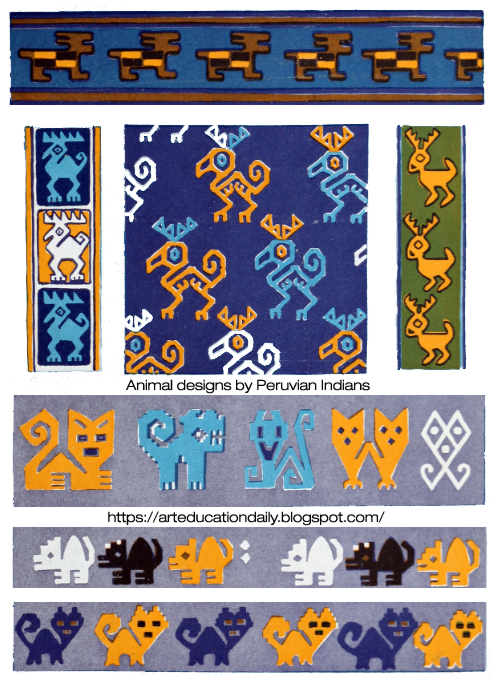
Designs by The Incan Indians of Peru

      "Below are designs from the work of the remarkable Inca Indians of Peru. The Inca designs have interested artists and designers around the world immensely, and influenced many craftsmen toward a simpler but more thoughtfully arranged form of motif." Lemos

Animal designs by Peruvian Indians of South America. 

Designs from old Inca Indian weavings found in Peru.

Bird, animal, fish and plant designs made by the Inca of Peru.

Bird borders from textiles and pottery designed by
the Indians of Peru, South America.

Peruvian Indian weaving and two bowls showing their
application of design to objects of utility.


Thursday, November 3, 2022

Hopi Ceremonial Artifacts

       The Hopi are a Native American tribe who primarily live on the Hopi Reservation in northeastern Arizona, United States. As of the 2010 census, there are 19,338 Hopi in the country. The Hopi Tribe is a sovereign nation within the United States and has government-to-government relations with the United States federal government. Particular villages retain autonomy under the Hopi Constitution and Bylaws. The Hopi language is one of 30 in the Uto-Aztecan language family. The majority of Hopi people are enrolled in the Hopi Tribe of Arizona but some are enrolled in the Colorado River Indian Tribes. The Hopi Reservation covers a land area of 2,531.773 sq mi (6,557.26 km2). Read more...

Color clip art of Hopi Ceremonial artifacts: dolls and woven crests from Arizona.

Clip Art of Popular Native American Artifacts

        Clip art page depicting popular cultural artifacts crafted by many Native American tribes include" bows and arrows, wampum drill, tom-tom drum and dance rattles. Students make wish to paste these resources inside of a journal about cultural artifacts or arts and craft methods.

Popular Native American Crafts.

Motifs for Native Pottery

       The Maricopa or Piipaash are a Native American tribe, who live in the Salt River Pima-Maricopa Indian Community and Gila River Indian Community along with the Pima, a tribe with whom the Maricopa have long held a positive relationship. The Maricopa at the Salt River Pima-Maricopa Indian Community consist mostly of Xalychidom Piipaash members and are concentrated in Lehi. The Maricopa at the Gila River Indian Community are concentrated in Maricopa Colony. The Maricopa are a River Yuman group, formerly living along the banks of the Colorado River. Read more...

       Below is a page of clip art depicting motifs from pottery made by Maricopa Natives: wavy lines, single loops and scrolls, double loops and scrolls. Students may wish to keep these samples in their journals to remember how they can decorate their own hand-built pots. 

Maricopa native motifs found on pottery.

Monday, October 31, 2022

How to Cast Plaster Tiles

        "How To Cast Plaster Tiles" for teachers and students to include in their journals and or lesson plans. The illustrated text is in black and white.

The text reads...

  1. Modeling clay is used to make plaque 1/2" thick.
  2. Put plaque in wall of cardboard 1 1/4" high & oil all surfaces with linseed or cooking oils.
  3. Pour in Plaster of Paris and smooth flush with top.
  4. When set pry pieces apart and oil the plaster surface.
  5. Repeat 2 & 3 using cast for mold & make as many tiles as desired. 
  6. Paint with tempera paints.
  7. Finish tile with many coats of clear lacquer as necessary to give the tile the look of a fired tile.

Step-by-Step Clip Art Illustration of Casting Plaster Tiles.

llustrations About The Story of Water Travel

       The following black and white thumbnail drawings are of the history of travel by sea, ocean or river. Each clip art shows the following: the log, the raft, air filled animal skins, reed raft, tree dugout boat and a wooden fishing boat. There are also kayaks, canoes and outriggers for the south seas. Boats and ships are included with oar rudders, sail and rudder. Big ships by Vikings, modern sportsmen, for fishing, Gondolas, sailboats and even a giant steam ship!


Clip Art Page About The History of Light

       A series of small simple illustrations in black and white depicting the History of Light include: fire light, candle light, torch light, tallow, grease light, oil lamps, fire beacon, tin lantern, a candle stick, a glass lantern, electric light bulbs, gas asbestos and an oil lamp.

History of the stove clip art page

       The page below depicts the history of the stove as it relates to multiple purposes. The black and white illustrations include: an altar, a tile oven from Europe, a Pueblo fireplace, a series of campfires and fire places, wood and coal burners, gas stoves and finally an electric stove.

Sunday, October 30, 2022

Things found in the art classroom...

       Things found in the art classroom include: a brayer set, paint brushes, garbage cans, wood tools, charts, bulletin boards, block printing equipment, paper easels nail box and a bulletin board. These clip art  pages are for students and teachers to use within the context of a classroom only. They may not be sold or republished from alternative resources.


       More supplies found in an art classroom might include the following clip art: shelves, windows, saw horse, benches, drawing benches, drawing boards, file cabinets and jars of paint.

Click to download the largest file size.

Sunday, October 23, 2022

The history of the wheel clip art page

       The following clip art page by Lemos is based upon the history of the wheel from many different cultures, throughout human history. Cultures included here: Ancient Egypt, Ancient Rome,  Ancient India, Assyria, Ancient Greece, France, China and others. The clip art is in black and white and would make a nice page to include inside a student journal about designs, inventions, cultures, etc...

Encourage students to sketch inside their journals in order to sharpen their memory.

Saturday, September 10, 2022

vintage clip art of compasses

      Illustrations of compasses for the classroom below are for exploration on land and at sea.

Find your way wherever you are.

A Mariner's compass for sea voyages.


Tuesday, June 22, 2021

"Ferment" by Roxy Paine

The first view of "Ferment" by Roxy Paine.

       Roxy Paine was born in 1966, New York City and is an American artist. He was educated at both the College of Santa Fe (now Santa Fe University of Art and Design) in New Mexico and the Pratt Institute in New York.
       Since 1990, Paine's work has been internationally exhibited and is included in major collections such as the De Pont Museum of Contemporary Art, Tilburg, The Netherlands; Hirshhorn Museum, Washington, D.C.; Israel Museum, Jerusalem; Museum of Modern Art, New York, NY; San Francisco Museum of Modern Art, CA; and the Whitney Museum of American Art, New York, NY. His dendroid sculptures can be found at various museums and foundations including the Olympic Sculpture Park, Seattle; Wanas Foundation, Knislinge, Sweden; Montenmedio Arte Contemporaneo NMAC, Cadiz, Spain; the Nelson-Atkins Museum of Art, Kansas City; the Crystal Bridges Museum of American Art, Bentonville, Arkansas and the National Gallery of Canada, Ottawa, Ontario. Roxy Paine lives and works in Brooklyn and Treadwell, New York. Read more...

"Ferment" by Roxy Paine. A second view.

"Ricardo Cat" by Niki De Saint Phalle

"Ricardo Cat" by Niki De Saint Phalle.
Mosaic work: stones, mirror pieces, tiles etc...

       Niki de Saint Phalle was born on the 29th of October 1930 and she died on the 21rst of May 2002. She was a French-American sculptor, painter, and filmmaker. She was one of the few women artists widely known for monumental sculpture.
       She had a difficult and traumatic childhood and education, which she wrote about decades later. After an early marriage and two children, she began creating art in a naïve, experimental style. She first received world-wide attention for angry, violent assemblages which had been shot by firearms. These evolved into Nanas, light-hearted, whimsical, colorful, large-scale sculptures of animals, monsters, and female figures. Her most comprehensive work was the Tarot Garden, a large sculpture garden containing numerous works ranging up to house-sized creations. Her idiosyncratic style has been called "outsider art"; she had no formal training in art, but associated freely with many other contemporary artists, writers, and composers.
       Throughout her creative career, she collaborated with other well-known artists such as Jasper Johns, Robert Rauschenberg, Larry Rivers, composer John Cage, and architect Mario Botta, as well as dozens of less-known artists and craftspersons. For several decades, she worked especially closely with Swiss kinetic artist Jean Tinguely, who also became her second husband. In her later years, she suffered from multiple chronic health problems attributed to repeated exposure to glass fibers and petrochemical fumes from the experimental materials she had used in her pioneering artworks, but she continued to create prolifically until the end of her life. Read more...

Backside views of "Ricardo Cat"

Inside and up-close views of Niki De Saint Phalle's "Ricardo Cat"


"Vase de Fleurs" by Pierre Bonnard

"Vase de Fleurs" by Pierre Bonnard.

       Pierre Bonnard was born in  Born in Fontenay-aux-Roses, in the Ile-de-France, France in 1867 and he died in 1947. He studied at the Academie Jullian, where he met Vuillard, Maurice Denis, K. X. Roussel, and Serusier, with whom he participated in the Nabis. As a young student he was influenced by Degas, Renoir, Van Gogh, and Toulouse-Lautrec, and developed a great interest in Japanese prints. In 1891 he exhibited for the first time at the Salon des Independants and in group shows with the Nabis. Five years later he had his first one-man show of paintings, posters, and lithographs at Durand-Ruel's. During this period his lithographs appeared in the Revue Blanche and L'Escarmouche, as well as in a portfolio called Quelques Aspects de la Vie de Paris which Vollard published in 1895. He also worked on sets, costumes, and posters for the Theatre de l'CEuvre and the Theatre des Pantins and modeled marionettes for a play with music by his brother-in-law, Claude Terrasse. In 1900 Ambroise Vollard commissioned him to illustrate with lithographs Parellilement and Daphnis et Chloi. Both are masterpieces of graphic art. In 1903 Bonnard exhibited in the first Salon d'Automne and in the Viennese Secession show and subsequently participated in many important exhibitions in Europe and America. He also had a number of one-man shows in Paris, London, New York, and other cities. His style, at first decorative and subdued in color, became much freer and brighter after 1900. Transposing the universe into colors, he painted landscapes, still lifes, and nudes transfigured by a shining light. Revolting against the fashions and theories of his contemporaries, Bonnard went his own way. He was an extremely modest man and very hard on himself, but his work is characterized by a charming ever-youthful, good-natured cheerfulness and by an increasing audacity of color harmonies. In 1912 he bought a house at Vernnet, in the Seine Valley, not far from Paris, and subsequently divided his time between there and the south of France. He died in 1947 in his house in Le Cannet on the Cote d'Azur.

"Sunflowers" by Van Gogh

"Sunflowers" by Vincent Van Gogh

       Born into an upper-middle-class family, Van Gogh drew as a child and was serious, quiet and thoughtful. As a young man he worked as an art dealer, often travelling, but became depressed after he was transferred to London. He turned to religion, and spent time as a Protestant missionary in southern Belgium. He drifted in ill health and solitude before taking up painting in 1881, having moved back home with his parents. His younger brother Theo supported him financially, and the two kept up a long correspondence by letter. His early works, mostly still lifes and depictions of peasant labourers, contain few signs of the vivid color that distinguished his later work. In 1886, he moved to Paris, where he met members of the avant-garde, including Émile Bernard and Paul Gauguin, who were reacting against the Impressionist sensibility. As his work developed he created a new approach to still lifes and local landscapes. His paintings grew brighter in colour as he developed a style that became fully realised during his stay in Arles in the south of France in 1888. During this period he broadened his subject matter to include olive trees, cypresses, wheat fields and sunflowers.