Monday, October 10, 2011

St. Patrick's Day Bulletin Boards


Above, Irish Potato Plots. Below, Essays about folklore

      Above a funny little leprechaun hugs a sack of potatoes in the top bulletin board. My mother then wrote about facts surrounding the Irish potato famine on each potato. In the example below an old-fashioned potato man adorns the second bulletin board. Children then wrote essays about Irish celebrations and colored mythical little leprechauns to decorate their project. Teachers can use holidays to teach the history of folklore or of the people most associated with a selected holiday. These kinds of visual connections between holiday themes and social studies or the teaching of classic literature help young students to understand the meanings behind the images used during holiday celebrations.

More links to St. Patrick's Day bulletin board ideas:

Spring Themes for Bulletin Boards


"What a Catch!"

"Fishing For Good Behavior"

"What a Plant Needs"

       Above are a few of the ideas my mother included on spring bulletin boards. "What a Catch!" was one of her favorite themes because the net element included essays that each child had written about a sea creature for their science unit. She thought the combination of two subjects, both science and English, was a wonderful way to insure students remembered their learning experiences.
      Bulletin boards can also cover topics such as discipline. The "fishing for good behavior bulletin board" was meant to reinforce class rules in a playful way. My mother would take a paper worm with a written principle of behavior on it, and place it on the hook of the fishing dog. Each child in the room would be represented by a paper fish below in the pond and some years her students would even craft their own fish. But, every student knew which fish was their own. She would then mark on a chart of good behaviors which fish were caught on the fishing line that week. Believe it or not, this was a successful motivation tool! Her young students would obey the rules just to see their fish get hooked.
      The third bulletin board was based on the growth cycle of a flower and also the names of each element of a flower. Sometimes it is difficult for small children to remember ideas and names without seeing these over and over. Bulletin boards help to reinforce visual memory and stimulate the "hows" of what they are reading. In this way, my mother taught me that a bulletin board is a very helpful tool for teachers to train students with.

More Spring themes for bulletin boards:

Science, Weather, Botany & Geography Bulletin Boards


Mammals, hunters, defenders

butterfly life cycle

weather watchers

living organisms

The sun's family

       The above examples are of the bulletin boards that represented the units of study in science that my mother taught every semester. The above examples where used to cover a small corner near a window. I recommend also, that teachers make available a small selection of books representing the study units' subjects be placed on a table below. Don't forget to think about objects that may also be included on the table that will stimulate a child's learning through sensory means as well. Listed here are more helpful hints for science displays:

1.  If your science unit includes some sort of life cycle of small animals, you may wish to include objects like a turtle shell, fur skin, old bones, teeth, or stuffed animals.
2. If your unit is about some sort of botany, then you could include objects such as interesting bark, a terrarium, potted plants, or maybe a selection of seeds planted in small plastic, see-through cups so the children could observe the growth of their plants.
3.  If your unit is about planets, you could hang painted foam planets from the ceiling.
4.  If your unit is about geography you may wish to include a spinning globe on the table.

contributing to local community events

The following are photographs of the opening night exhibit at Central Presbyterian Church, 2010. I have served on the jury for this congregation's art exhibits for three years. In 2010, I also taught during a seminar along with five other artists during the church’s art festival. This festival has grown and expanded it’s agenda little by little each year. It is one of the ways in which I have truly enjoyed using my time and talents to teach others about art outside of a secularized environment.
Left, artists Doug Merkey and Patt Tiemeir at the 2010
Central Presbyterian Art Exhibit. Right, is one of the
many lovely marble carving submitted for the show that year.
Above is a sculpture by Brother Mel. He always exhibits
liturgical works for local St. Louis shows in church communities.
Above is a marvelous wood carving from the 2010 exhibit.
Fine photography is frequently displayed during these art shows as well.
Of course, there is always good food. Here are the
volunteers bringing in the appetizers.

make your art program visible

Ceramic cupcake display.
       Making art programs visible is necessary for the growth and appreciation of the fine arts in American public schools. I’ve included a listing here of many methods I have either observed or participated in during my student teaching experience, art internship, observation hours, volunteer services, and also as a paid professional.
  1. Publish a monthly or annual newsletter.
  2. Develop online resources for yourself and others.
  3. Request excellent books and magazine publications for the library.
  4. Keep literary publications about art in a three-ring binder at the library for students to access while doing research or homework assignments.
  5. Make sure exhibits are hung during other major school events that do not normally involve art curriculum. 
  6. Take art students on field trips.
  7. Start and maintain an art club.
  8. Participate in annual art competitions.
  9. Participate in your school district exhibitions.
  10. Notify parents when their children’s artworks are included in art exhibits.
  11. Invite resident artists to your classroom to talk with students about their interests.
  12. Keep a rotating exhibit in your building at all times.
  13. Offer student artwork for office spaces within your building or school district office buildings.
  14. Provide to students opportunities to work in both small and large groups.
  15. Assign lessons that include current events.
  16. Include individual work and or students in published art magazines or newsletters.
  17. Conduct fund-raisers to support the needs of your art department.
  18. Allow older, responsible, art students to teach or mentor younger art students.
  19. Attend and get involved in art conferences. 
  20. Create and participate in interdisciplinary lessons with your fellow teachers.
  21. Keep informed about new techniques used in contemporary art classrooms.
  22. Encourage art students to actively participate in school spirit week.
  23. Involve art students in the building and decorating of school drama and musical sets, costume design, makeup, tech crews and props.
  24. Assign to senior art students the brochures and posters used to publicize school events.
  25. Encourage art students to get involved with excellent charitable organizations in your area or nationally.
  26. Develop annual publications for students in house that may be used in their own portfolios for college applications.
  27. Include current computer technology relevant to the research and/or application of lessons/artworks.
  28. Develop in art students an understanding and appreciation for their artistic heritage.
  29. Encourage art students to pursue art careers in practical ways by attainable means.
  30. Be well informed concerning college entrance requirements and teach your advanced students to keep goals that include these requirements should they consider these seriously in their future.
  31. Encourage parents to support their talented children realistically within the limits of their cultural values or budgets.
  32. Research and implement about those standards required of your fellow educators and administrators so that you might help them through your own artistic interests.
  33. Keep your own interests formal but lively in the public forums and on the internet.

My CT stands by one of her many student, garden 
displays at Rockwood Elementary School. These 
paving stones and mural are installed at the front 
of her school building. She has many displays
of her students’ artwork in the halls and even 
outdoors at her school.

classroom bulletin boards

Above is a picture of my mother in her former
  3rd/4th grade combined classroom.

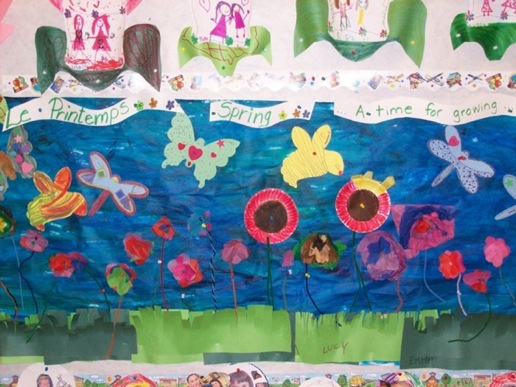
      A bright and cheerful classroom makes an exciting place for children to learn in. Every summer my mother would ponder over her resources and ideas for bulletin boards. She loved to decorate her classroom with the art projects her students created. Incorporating subjects such as book reports, history, scientific principles, and literature were always popular themes in her classroom, as well as the holidays. She frequently purchased books on the subject of decorating bulletin boards or checked them out from the local library. She believed that displaying children's work helped to build self-esteem and provided for them a stimulating environment for further education.
      I will be posting a few snapshots here that were taken of her classroom bulletin boards. She retired five years ago but we imagine that some of the resources she used are still circulating.

Photographs of bulletin boards from my mother's former elementary classroom:
  1. music bulletin boards, Bulletin Board Ideas for Music Teachers  
  2. teachervision, Bulletin Board Ideas 
  3. Clayton, Bulletin Board Ideas for Library Media Specialists 
  4. bulletinboardpro, Bulletin Board Pro       
  5. teachertools, Bulletin Boards 
  6. gigglepotz, Bulletin Boards Across the World 
  7. teachingheart,Bulletin Boards and Tips for the K-3 Teacher 
  8. teachnet, Bulletin Boards Library 
  9. Carroll, Business Education Bulletin Board Ideas 
  10. boardsgalore, Church and School Bulletin Board Ideas 
  11. Classroom Displays and Bulletin Boards 
  12. DTLK's Bulletin Board Displays 
  13. garden of praise, Halls, Walls, and Bulletin Boards 
  14. Kim's Korner, Ideas for Bulletin Boards 
  15. faculty kutztown, Interactive Bulletin Boards: Secondary School Math 
  16. Teacher's Corner: Bulletin Board Ideas 
  17. WPS Bulletin Boards 
  18. Middle School Bulletin Boards 
  19. Teaching Tips: Bulletin Boards
  20. Bulletin Boards Woes 
  21. We're Bugging Out All Over! 
 Links to other website owners that cover the topic of Sunday School bulletin boards:

Interview by A Local Press

Here I am with just a few of the rag dolls 
that I used to instruct course work with at the 
Burlingame Parks and Recreation Center, California
A long, long time ago, in a time that seems like ancient history, I was interviewed by Sherry Posnack-Goodwin for the San Mateo County Times newspaper. The article appeared as a large spread in the local paper and it really helped the community parks and recreation center at Burlingame sell the course I was scheduled to teach there. Part of the difficulty administrators have in promoting classes is that there is often little time or money to actually advertise the class. In this case, the administrator believed that the class would be an excellent human interest story because of its’ cross-curriculum flavor. During this class, I introduced historic doll methods with a combination of storytelling and early American history. Young students in the class enrolled with a family “partner,” meaning a mother or grandmother, who would cooperate with the child and sew a topsy-turvy doll together. Each partner was to make one half of a doll and then connect the two ends together in order to create one completed version of the historical character. The class was a giant hit! I taught over forty people for this brief class that lasted four or six weeks, I can’t really recall exactly how long it lasted.
Above is just one of the many sample topsy-turvy 
dolls that I spoke about. This one is a historical 
prototype based on a drawing of an original 
found on a old southern plantation