Monday, October 10, 2011

Christmas Subjects for Bulletin Boards

    The next selection of pictures show children's artwork during the month of December in specific. Stockings are always fun to color and design. These children made up their own patterns and pictures. Giant paper carolers sing silently in the corner of this classroom and the teacher displayed a paper tree on her bulletin board along with essays about how each child will celebrate the holidays. Some teachers consider these Christmas subjects to be less about religion and more about American Christmas practices in general. It is up to the individual teacher to determine the benefits and deficits of the celebration of popular holidays in their classrooms. I will include a wide variety of bulletin board ideas on my blog, both secular and religious.

Christmas stockings hung by the coat rack with care.
Christmas stockings hung by the bookcase for Santa
caroling sweetly
Christmas tree bulletin board
More Ideas For Christmas Bulletin Boards:

Bulletin Boards For Reading Corner


"Sneaking Up On a Good Book"

"Best Sneaker Forward!"

An apple orchard in the reading corner.

"Poppin' Good Study Habits!"

"Don't Monkey Around!"

      The first and top example of a "reading corner" or what may now be in most classrooms, "a computer corner," is a bulletin board that shows off students’ book reports. The second bulletin board is what most teachers refer to as a rewards chart. If a child completes a task promptly or obeys particular class rules well, he gets to tape a sneaker with his name on it, on the wall along with other fellow students. The "Poppin' good study habits" bulletin board is the same type of rewards bulletin board. Students who finish their projects on time are rewarded by inclusion with others, posted where everyone can see their good efforts. The "Don't monkey around!" bulletin board is a motivational bulletin board based on good study habits. Bananas are taped up on the wall when each child is recognized for excellent study habits. Last but not least, the apple orchard is a pleasant welcome for new students and invites children to relax and read a good book quietly when they have completed their studies.

More Ideas for Decorating Your Classroom Reading Corner:

St. Patrick's Day Bulletin Boards


Above, Irish Potato Plots. Below, Essays about folklore

      Above a funny little leprechaun hugs a sack of potatoes in the top bulletin board. My mother then wrote about facts surrounding the Irish potato famine on each potato. In the example below an old-fashioned potato man adorns the second bulletin board. Children then wrote essays about Irish celebrations and colored mythical little leprechauns to decorate their project. Teachers can use holidays to teach the history of folklore or of the people most associated with a selected holiday. These kinds of visual connections between holiday themes and social studies or the teaching of classic literature help young students to understand the meanings behind the images used during holiday celebrations.

More links to St. Patrick's Day bulletin board ideas:

Spring Themes for Bulletin Boards


"What a Catch!"

"Fishing For Good Behavior"

"What a Plant Needs"

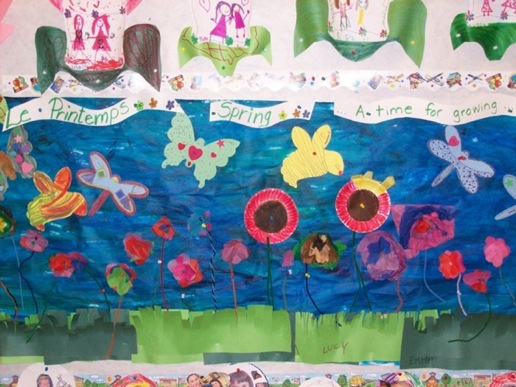
       Above are a few of the ideas my mother included on spring bulletin boards. "What a Catch!" was one of her favorite themes because the net element included essays that each child had written about a sea creature for their science unit. She thought the combination of two subjects, both science and English, was a wonderful way to insure students remembered their learning experiences.
      Bulletin boards can also cover topics such as discipline. The "fishing for good behavior bulletin board" was meant to reinforce class rules in a playful way. My mother would take a paper worm with a written principle of behavior on it, and place it on the hook of the fishing dog. Each child in the room would be represented by a paper fish below in the pond and some years her students would even craft their own fish. But, every student knew which fish was their own. She would then mark on a chart of good behaviors which fish were caught on the fishing line that week. Believe it or not, this was a successful motivation tool! Her young students would obey the rules just to see their fish get hooked.
      The third bulletin board was based on the growth cycle of a flower and also the names of each element of a flower. Sometimes it is difficult for small children to remember ideas and names without seeing these over and over. Bulletin boards help to reinforce visual memory and stimulate the "hows" of what they are reading. In this way, my mother taught me that a bulletin board is a very helpful tool for teachers to train students with.

More Spring themes for bulletin boards:

Science, Weather, Botany & Geography Bulletin Boards


Mammals, hunters, defenders

butterfly life cycle

weather watchers

living organisms

The sun's family

       The above examples are of the bulletin boards that represented the units of study in science that my mother taught every semester. The above examples where used to cover a small corner near a window. I recommend also, that teachers make available a small selection of books representing the study units' subjects be placed on a table below. Don't forget to think about objects that may also be included on the table that will stimulate a child's learning through sensory means as well. Listed here are more helpful hints for science displays:

1.  If your science unit includes some sort of life cycle of small animals, you may wish to include objects like a turtle shell, fur skin, old bones, teeth, or stuffed animals.
2. If your unit is about some sort of botany, then you could include objects such as interesting bark, a terrarium, potted plants, or maybe a selection of seeds planted in small plastic, see-through cups so the children could observe the growth of their plants.
3.  If your unit is about planets, you could hang painted foam planets from the ceiling.
4.  If your unit is about geography you may wish to include a spinning globe on the table.

contributing to local community events

The following are photographs of the opening night exhibit at Central Presbyterian Church, 2010. I have served on the jury for this congregation's art exhibits for three years. In 2010, I also taught during a seminar along with five other artists during the church’s art festival. This festival has grown and expanded it’s agenda little by little each year. It is one of the ways in which I have truly enjoyed using my time and talents to teach others about art outside of a secularized environment.
Left, artists Doug Merkey and Patt Tiemeir at the 2010
Central Presbyterian Art Exhibit. Right, is one of the
many lovely marble carving submitted for the show that year.
Above is a sculpture by Brother Mel. He always exhibits
liturgical works for local St. Louis shows in church communities.
Above is a marvelous wood carving from the 2010 exhibit.
Fine photography is frequently displayed during these art shows as well.
Of course, there is always good food. Here are the
volunteers bringing in the appetizers.

make your art program visible

Ceramic cupcake display.
       Making art programs visible is necessary for the growth and appreciation of the fine arts in American public schools. I’ve included a listing here of many methods I have either observed or participated in during my student teaching experience, art internship, observation hours, volunteer services, and also as a paid professional.
  1. Publish a monthly or annual newsletter.
  2. Develop online resources for yourself and others.
  3. Request excellent books and magazine publications for the library.
  4. Keep literary publications about art in a three-ring binder at the library for students to access while doing research or homework assignments.
  5. Make sure exhibits are hung during other major school events that do not normally involve art curriculum. 
  6. Take art students on field trips.
  7. Start and maintain an art club.
  8. Participate in annual art competitions.
  9. Participate in your school district exhibitions.
  10. Notify parents when their children’s artworks are included in art exhibits.
  11. Invite resident artists to your classroom to talk with students about their interests.
  12. Keep a rotating exhibit in your building at all times.
  13. Offer student artwork for office spaces within your building or school district office buildings.
  14. Provide to students opportunities to work in both small and large groups.
  15. Assign lessons that include current events.
  16. Include individual work and or students in published art magazines or newsletters.
  17. Conduct fund-raisers to support the needs of your art department.
  18. Allow older, responsible, art students to teach or mentor younger art students.
  19. Attend and get involved in art conferences. 
  20. Create and participate in interdisciplinary lessons with your fellow teachers.
  21. Keep informed about new techniques used in contemporary art classrooms.
  22. Encourage art students to actively participate in school spirit week.
  23. Involve art students in the building and decorating of school drama and musical sets, costume design, makeup, tech crews and props.
  24. Assign to senior art students the brochures and posters used to publicize school events.
  25. Encourage art students to get involved with excellent charitable organizations in your area or nationally.
  26. Develop annual publications for students in house that may be used in their own portfolios for college applications.
  27. Include current computer technology relevant to the research and/or application of lessons/artworks.
  28. Develop in art students an understanding and appreciation for their artistic heritage.
  29. Encourage art students to pursue art careers in practical ways by attainable means.
  30. Be well informed concerning college entrance requirements and teach your advanced students to keep goals that include these requirements should they consider these seriously in their future.
  31. Encourage parents to support their talented children realistically within the limits of their cultural values or budgets.
  32. Research and implement about those standards required of your fellow educators and administrators so that you might help them through your own artistic interests.
  33. Keep your own interests formal but lively in the public forums and on the internet.

My CT stands by one of her many student, garden 
displays at Rockwood Elementary School. These 
paving stones and mural are installed at the front 
of her school building. She has many displays
of her students’ artwork in the halls and even 
outdoors at her school.